Resale shops face two walls: they can't sell online without risking selling a one-of-a-kind piece twice, and listing each piece by hand eats the day. I built Vessor to take down both, with a guard that makes a double sale impossible, and AI that drafts the listing from a photo or your voice.
vessor.ai
Role
Founder · Product, Design & Engineering
Year
2026
Tools & methods
Figma, Next.js, Supabase, Claude Code, Brand & interaction design
Overview
Vessor is an AI-native operating system for resale shops: any shop that sells one-of-a-kind goods, across clothing, accessories, records, furniture, collectibles, and art. It runs the whole shop in one tool: AI intake, cross-listing to every marketplace, consignor payouts, live-comp pricing, and two-way POS sync. I build and own the whole thing, the product, the brand, the design, and the full stack, front-end and back-end. Today's design partners are vintage and consignment shops, but the platform serves the far larger resale market.
The problem
Every piece in a resale shop is one-of-a-kind, which makes selling online quietly terrifying. List a handbag on eBay and sell it on the floor the same afternoon, and you have sold it twice. Now you are refunding and apologizing to a real buyer. So most shops stay behind their front door, invisible to every buyer who isn't standing in the room. The few that do go online run five separate tools to list, price, sell, pay consignors, and reconcile, and the consignor accounting lives in a spreadsheet nobody trusts.
Problem · two walls keep shops stuck
Problem 1 · the fear
Selling online means selling it twice
A piece is one of a kind. List it online and sell it on the floor the same day and you have double-sold it: a refund, an apology, a lost customer. So most shops stay offline.
Vessor’s answer
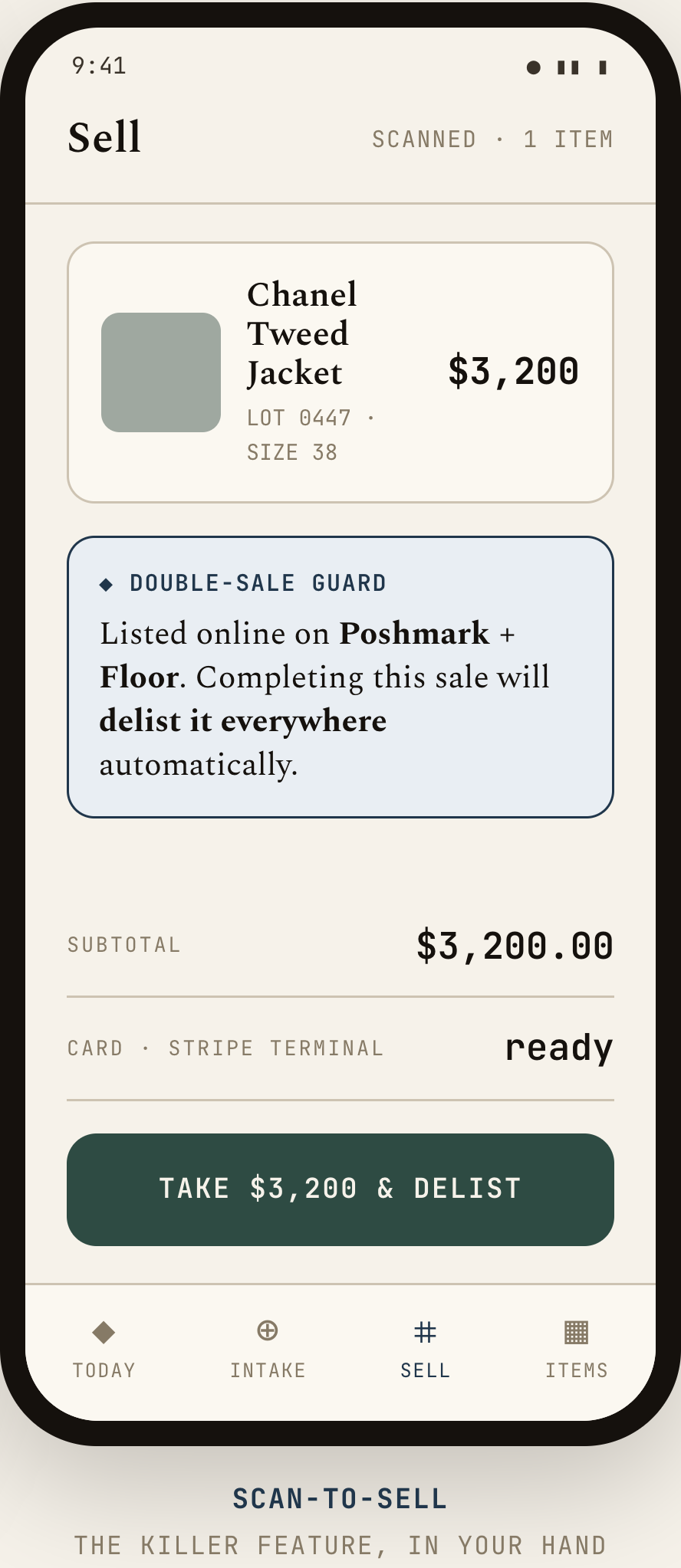
Never sell the same piece twice. The moment it sells anywhere, Vessor delists it everywhere else in real time.
Problem 2 · the grind
Getting it listed eats the day
Every piece has to be photographed, identified, priced, and posted by hand, across five separate tools, while consignor accounting lives in a spreadsheet nobody trusts.
Vessor’s answer
AI intake. Photograph a piece or describe it out loud and Vessor drafts the whole listing in seconds.
Vessor exists to take down both: make a double sale impossible, and make listing effortless.
Research & discovery
I built this alongside real shop owners, not from a market report. I demoed early versions to a luxury consignment owner who had never once sold online, to an owner-operated vintage shop, and worked through every screen with an industry veteran who had run a shop floor for years. The same thing surfaced every time: the blocker to selling online is not technology or effort, it is the fear of the double sale. One owner put a number on it without prompting: a single double-sold designer bag is a refund, an apology, and a customer who never comes back.
Research · what the floor told us
From the field
“The blocker isn’t tech or effort. It’s the fear of selling the same piece twice.”
A luxury consignment owner who had never once sold online.
Owner interviewsLive demos on real catalogsFloor walkthroughs with a shop veteran
I built this with shop owners, not from a market report, and the same fear surfaced in every single conversation.
Insights: the reframe
Remove the fear and the channel opens. Double-sale prevention is not a feature, it is the permission slip. Make it impossible to sell the same piece twice and a shop will finally put its floor online.
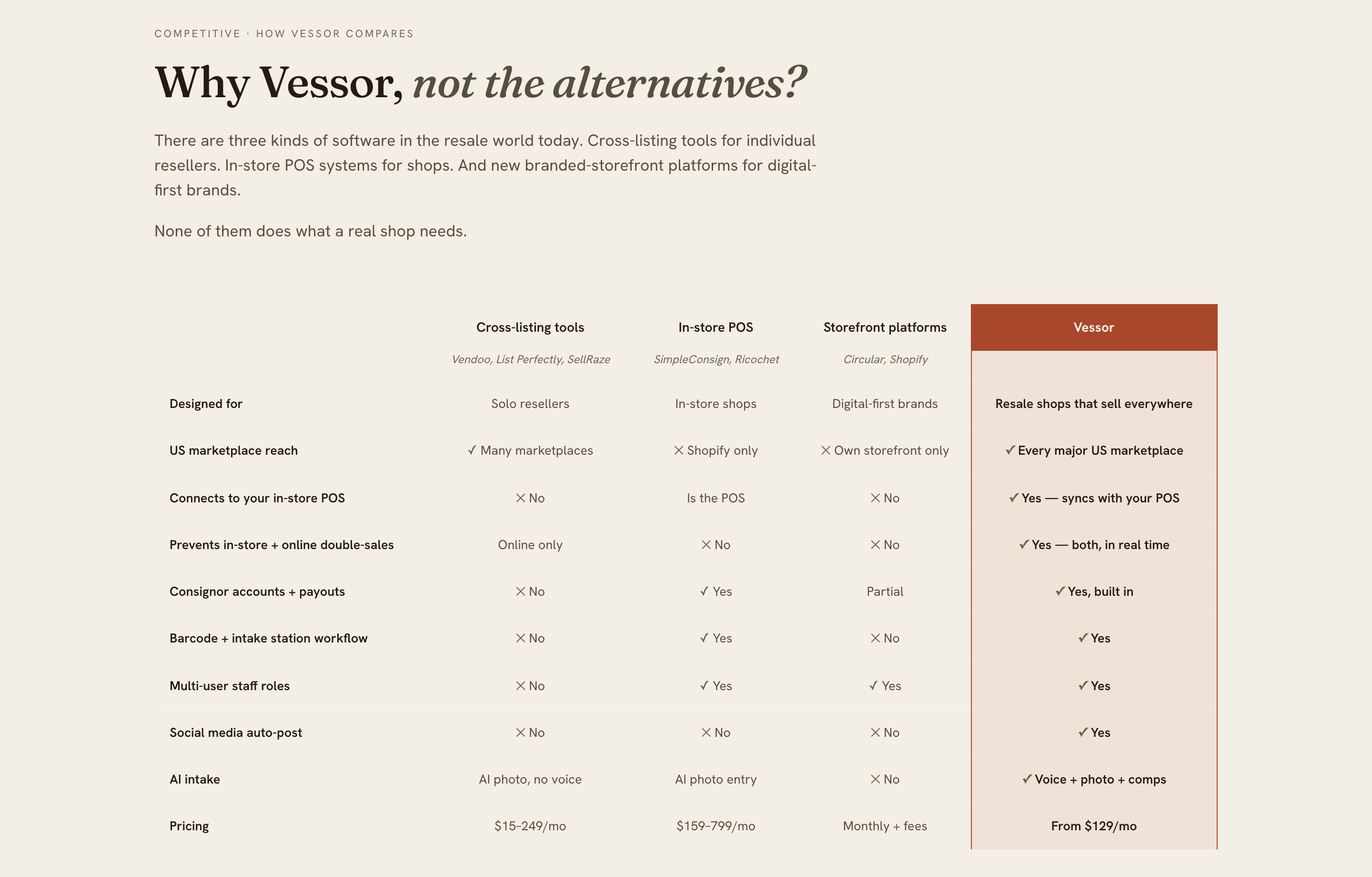
These are shops, not closet resellers. They have staff, a register, intake stations, and consignors. The crosslisting tools built for people working from home do not fit. Vessor had to be shop-grade.
The register is the moat. What keeps shops on aging software is consignor payouts and POS. With those incumbents sunsetting, becoming the register is the hardest part to build and the deepest moat to hold.
Insights · where Vessor sits
vessor.ai
Not a closet-reseller crosslister, and not a Shopify-only POS. Shop-grade, on every channel at once.
Exploration & iteration
The product is built around one decision, made first: never sell the same piece twice.
Solution · the moat: never sell the same piece twice
Sells in-store
Sells online · eBay
↓
Vessor delists it everywhere, in under a second
↓
Floor staff get a “pull from floor” alert with the location
safety netIf someone tries to ring it up again, the register blocks the sale.
Shops won’t list online because a double-sale means refunding and apologizing to a real customer. Remove that fear and the entire online channel opens up. This is the wedge.
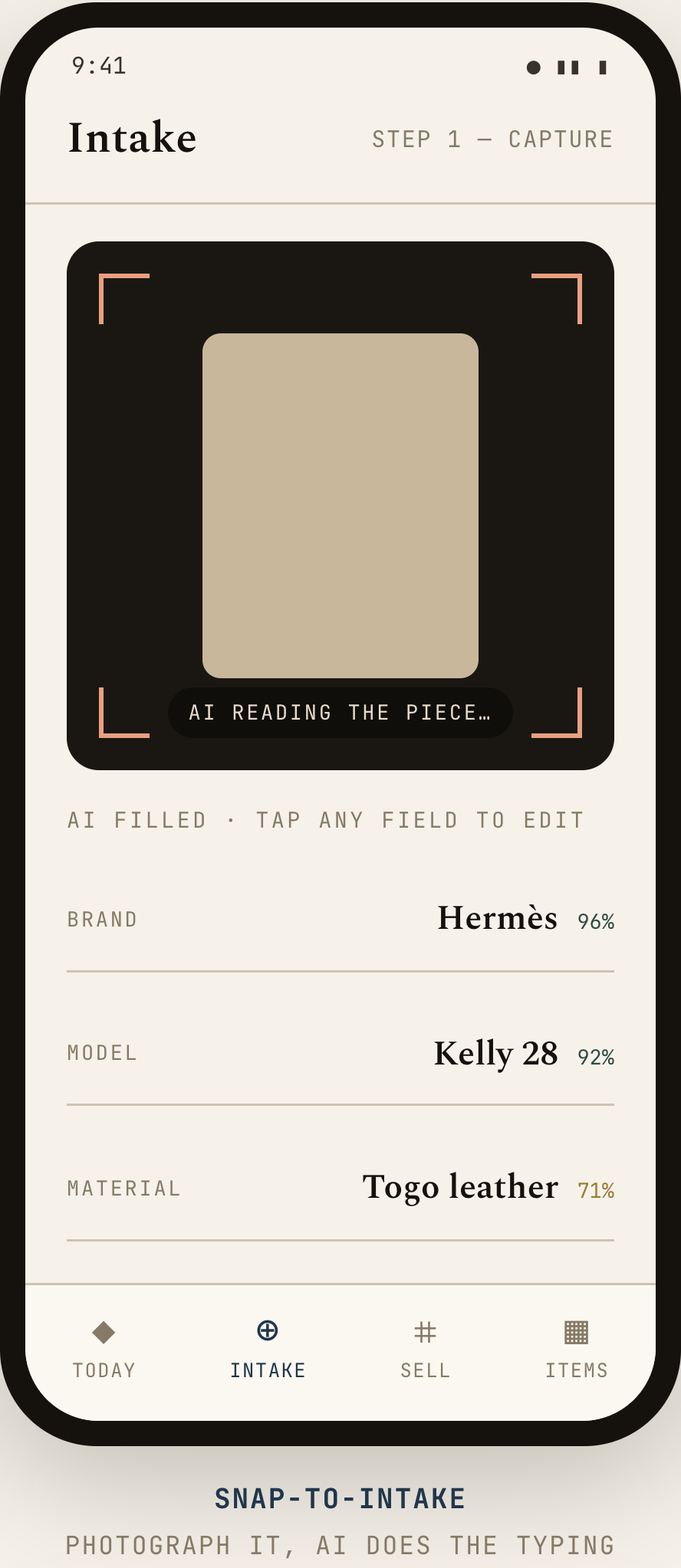
The other daily tax on a shop is listing. So I built two ways in: photograph the piece and let AI vision identify it (the path shops are reaching for), or describe it out loud. Both produce the same structured listing, and both stay honest about what they are not sure of.
Interaction model · two ways in, one set of fields
Snap a photoTaking off
AI vision identifies the piece straight from the image: brand, model, materials, condition.
Or describe itVoice
Talk through the piece while you keep working. Same result, hands-free.
Either way → the same structured listing
Brand
Chanel
99%
Model
Classic Flap
97%
Era
c. 1995
94%
Size
Medium
88%
Colour
Black
96%
Condition
Light wear?
63% · review
Materials
Caviar leather
91%
Features
Gold hardware
85%
The agent is honest about what it doesn’t know. It flags a low-confidence fieldinstead of bluffing. That’s what makes a shop owner trust it with a $9,000 handbag.
The design system
Resale software defaults to one of two looks, and both are wrong for a shop that charges a few hundred a month to run its livelihood.
Concepts · choosing a brand register
Direction ARejected
Vintage kitsch
Mustard, groovy fonts, distressed textures. Reads dated, and gets hard to actually use.
Direction BRejected
Dev-tool default
Dark mode, violet accent, generic Inter, left-border cards. Reads like a dev tool, and undercuts software a shop runs its livelihood on.
Direction CChosen
Vessor's own brand
Oxblood, Spectral, and JetBrains Mono. A system-of-record register, drawn from two explored directions.
The category default is kitsch or vibe-coded dark mode, and even my first editorial pass drifted toward the safe, expected look. So I gave Vessor an own brand: oxblood, with the rigor of a ledger and the restraint of a vault.
So I gave Vessor its own brand instead of a safe default: an oxblood accent and a system-of-record type system drawn from two directions I explored, the Ledger and the Vault.
Design system · Vessor's own brand
Type · Spectral & JetBrains Mono
Built like a ledger, not a dashboard.
LOT 0438 · HERMÈS KELLY 28 · 3 CHANNELS · $8,900
Spectral carries names with quiet-luxury restraint. JetBrains Mono carries every number and status, for the rigor of a system of record. A fusion of two directions I explored: the Ledger and the Vault.
Accent · oxblood
CHOSEN
Oxblood
#8A2B34
Terracotta
the safe default
Lapis
#2C57A0
Emerald
#1E6A4E
System palette · WCAG AA
Paper
#FBF8F1
Band
#EFEAE0
Ink
#15110D
Oxblood
#8A2B34
Ink-blue
#20364B
Sage
#2E6B4E
Line
#D7CDBB
I gave Vessor its own accent, oxblood, and a system-of-record type system. A brand that looks like Vessor, not like every other tool.
Mobile: early concepts
The desktop is where you manage the shop. The real work, though, happens on your feet, on the floor, holding the piece. So I concepted a mobile surface for exactly that: an adaptive companion, not a shrunk-down dashboard.
Mobile · early concepts
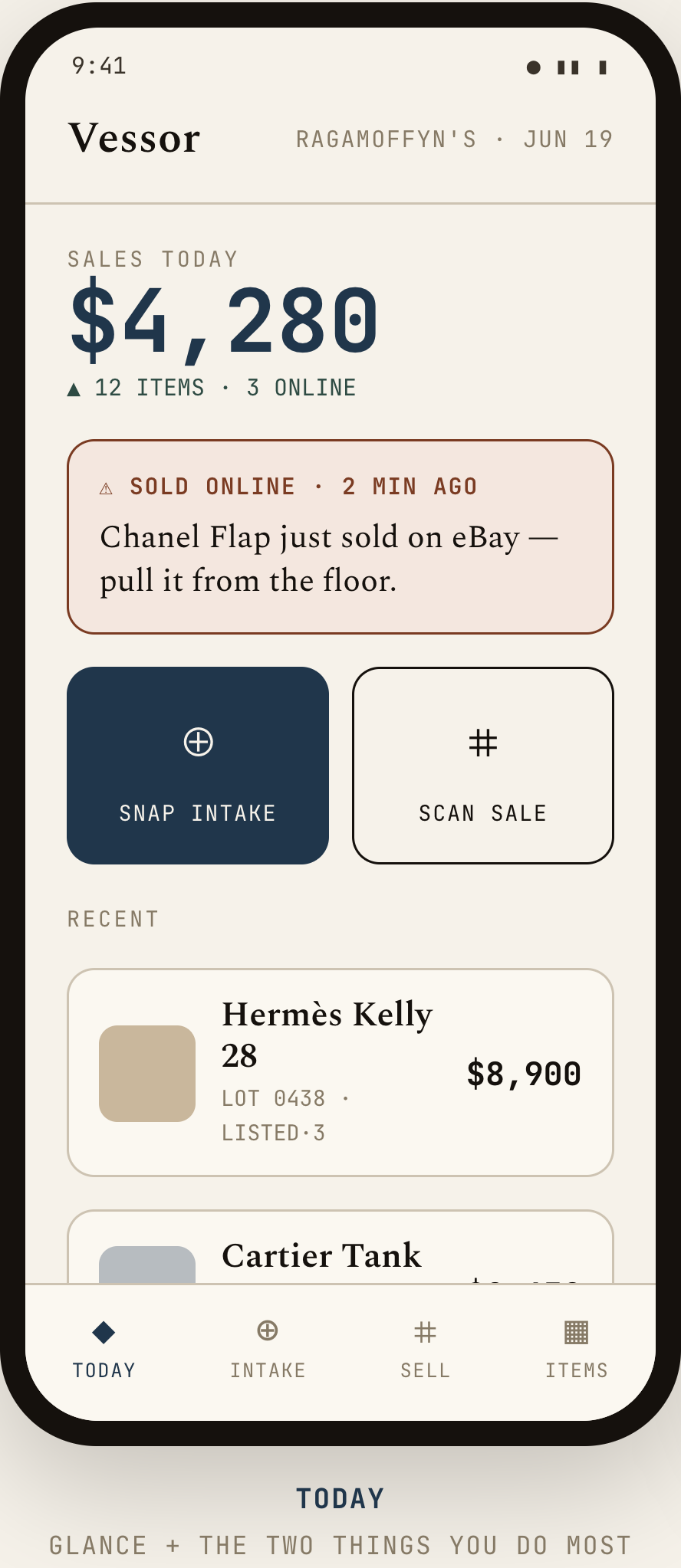
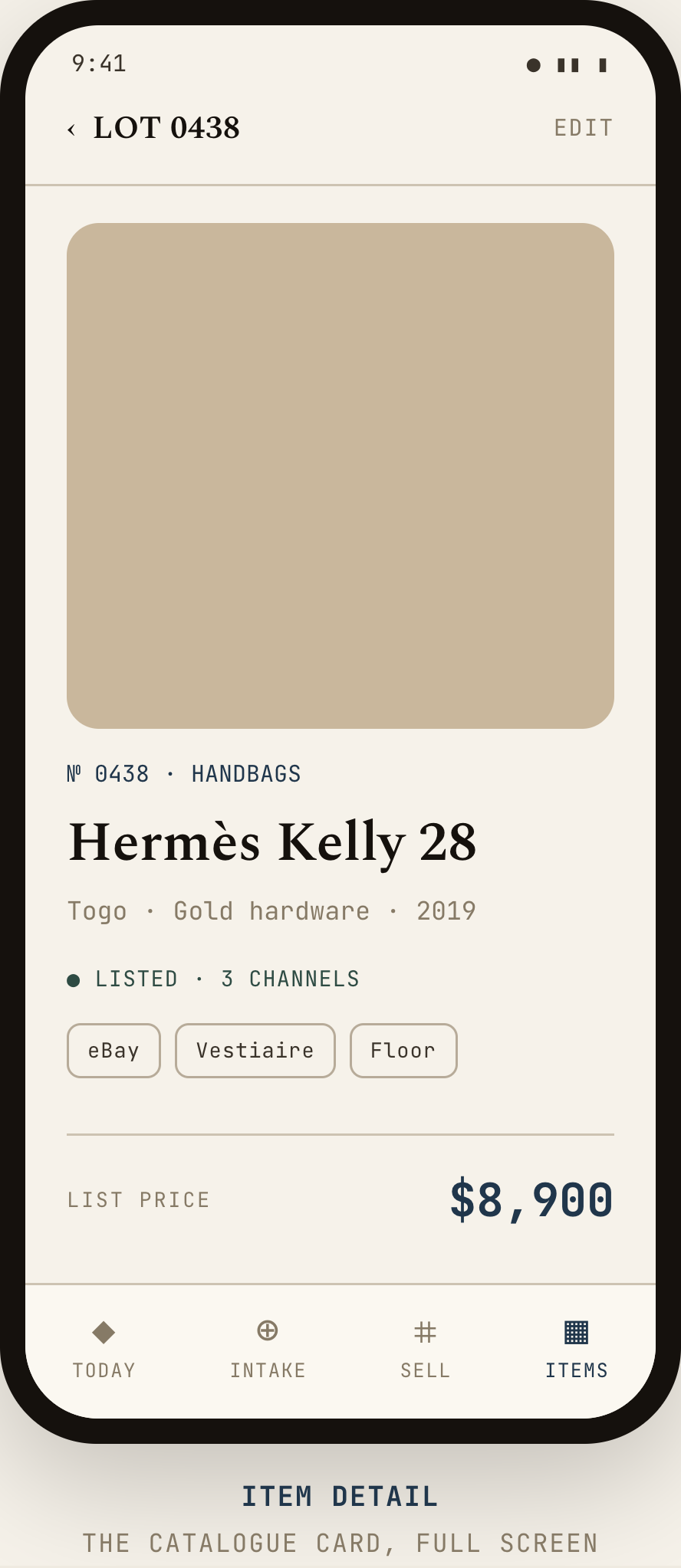
Today: the day at a glance, with a live double-sale alert and one-tap snap-intake or scan-sale.Snap-to-intake: photograph the piece on the floor and the AI fills the fields.Scan-to-sell with the double-sale guard: ring it up and it delists everywhere automatically.Item detail: lot number, condition, and where it is listed, in your hand.
The phone is for doing, not managing. An adaptive surface for the on-your-feet jobs (snap, scan, sell, glance), not a shrunk-down desktop. Same data, same system, different surface.
Validation
I pressure-tested the direction by putting bespoke demos in front of real shops and watching what landed, then changing the product to match what I heard.
Validation · what we heard → what we changed
What we heard
What I changed
Shops fear the double sale more than they crave the online upside.
Led the entire product with the double-sale guard, not the listing tools.
Owners will not run a second system beside their register.
Built one-click migration so Vessor can replace the register, not sit next to it.
Listing by hand is the grind that eats the day.
Made AI photo and voice intake the front door of the product.
Every demo with a real shop moved the product. One owner asked us to replace her register outright, which reversed our scope from add-on to system of record.
The solution
Vessor is the whole stack a shop runs, in one tool.
Product · web
vessor.ai
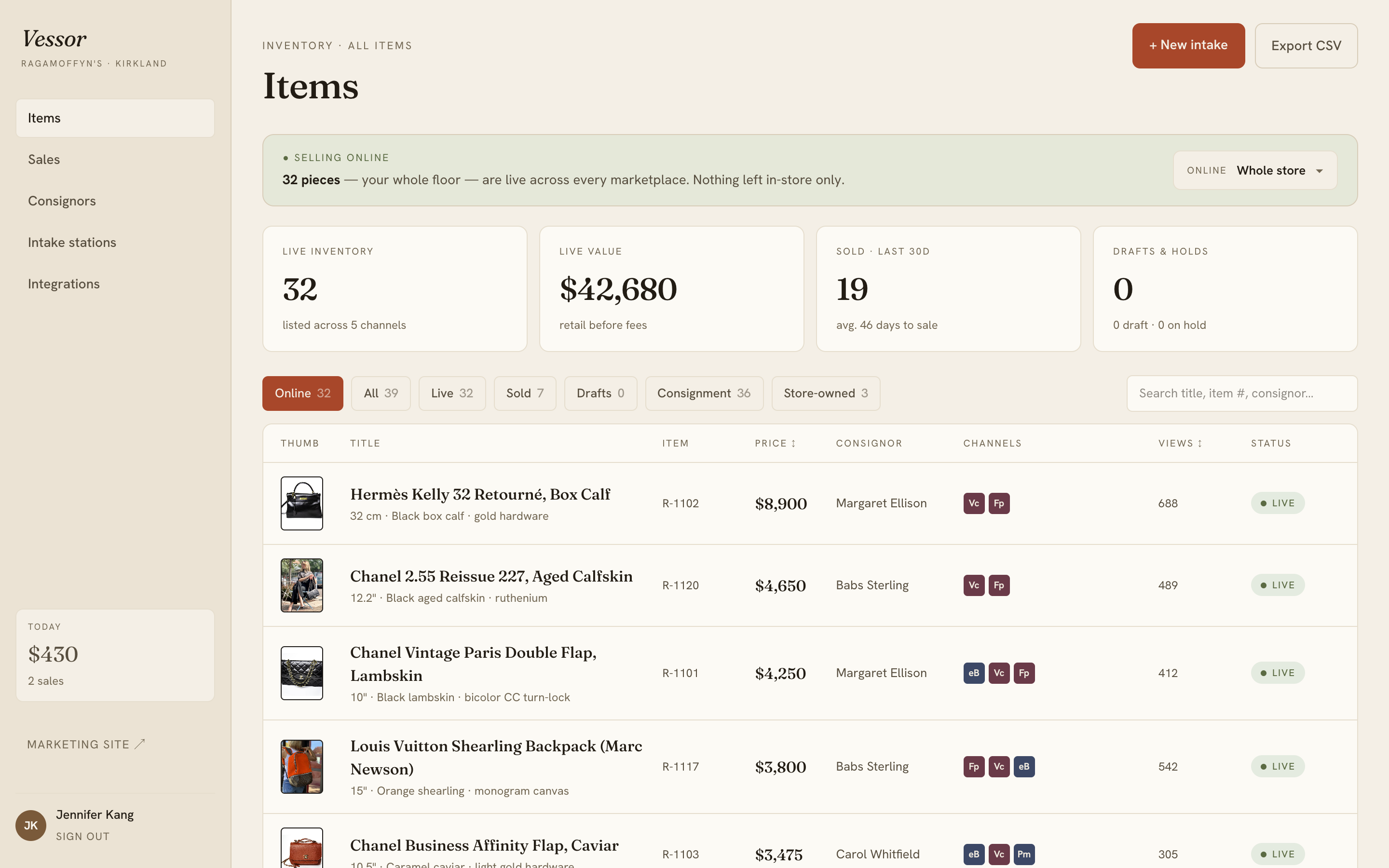
The shop floor in one view: every piece, its price, the channels it lives on, and which consignor it belongs to.
Product · web
vessor.ai
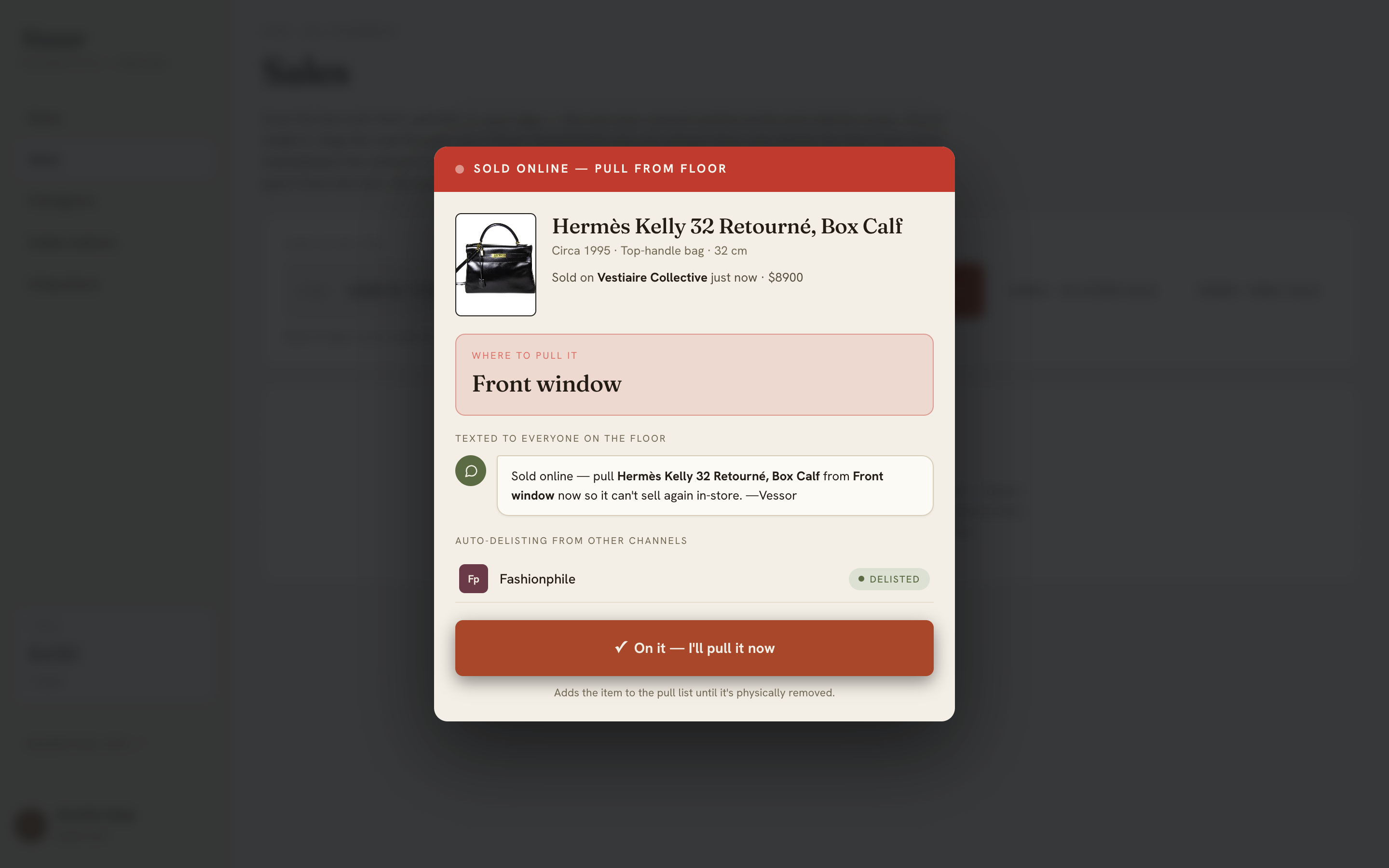
The moat in action. The instant a piece sells anywhere, Vessor delists it on every other channel and tells staff exactly where to pull it from.
This is the fear, removed. A shop can finally list its whole floor online without the refund-and-apologize risk that kept it offline.
Product · web
vessor.ai
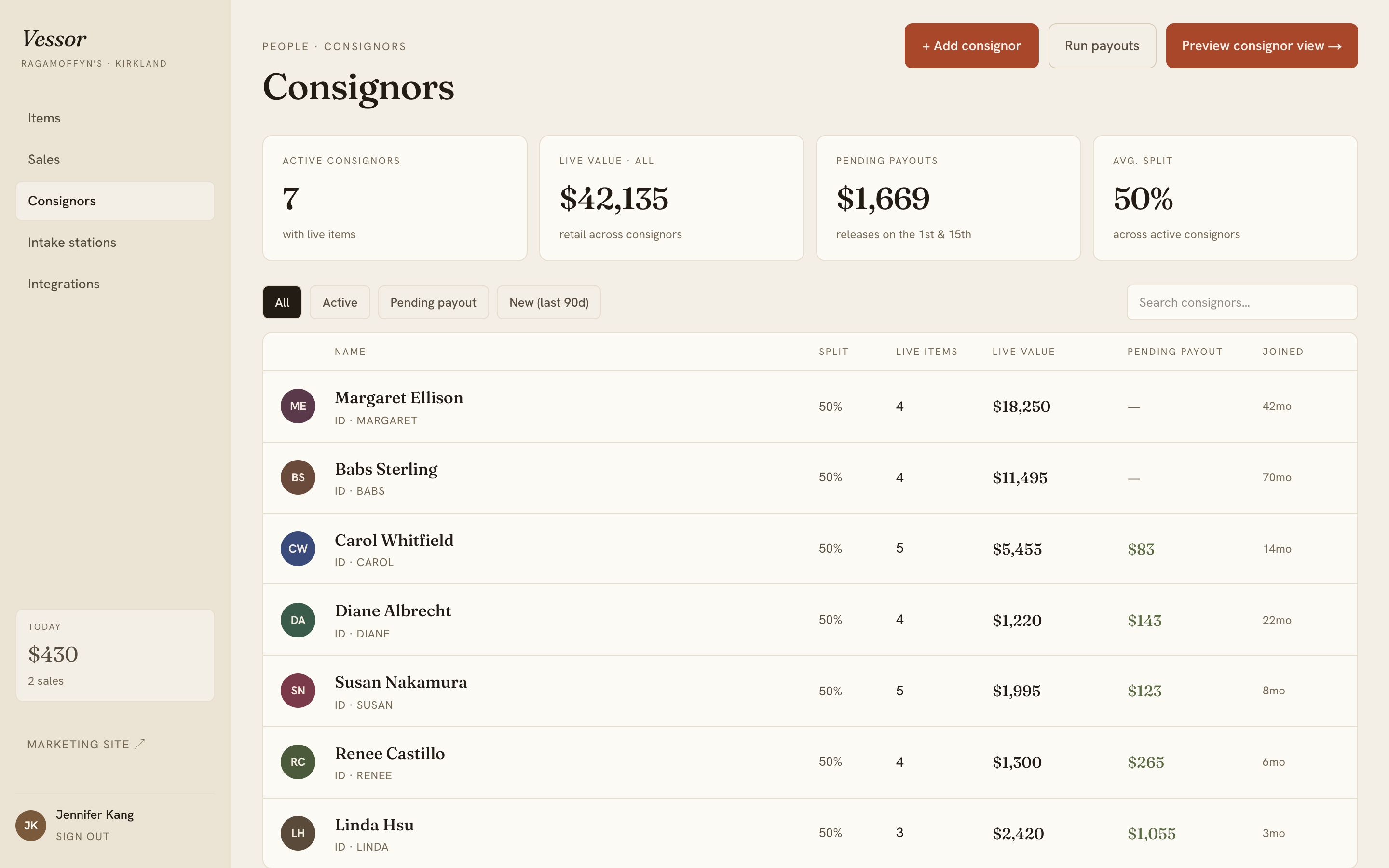
Consignor accounting built in: splits, payouts, and statements. The thing that keeps indie shops on legacy software.
Product · web
vessor.ai
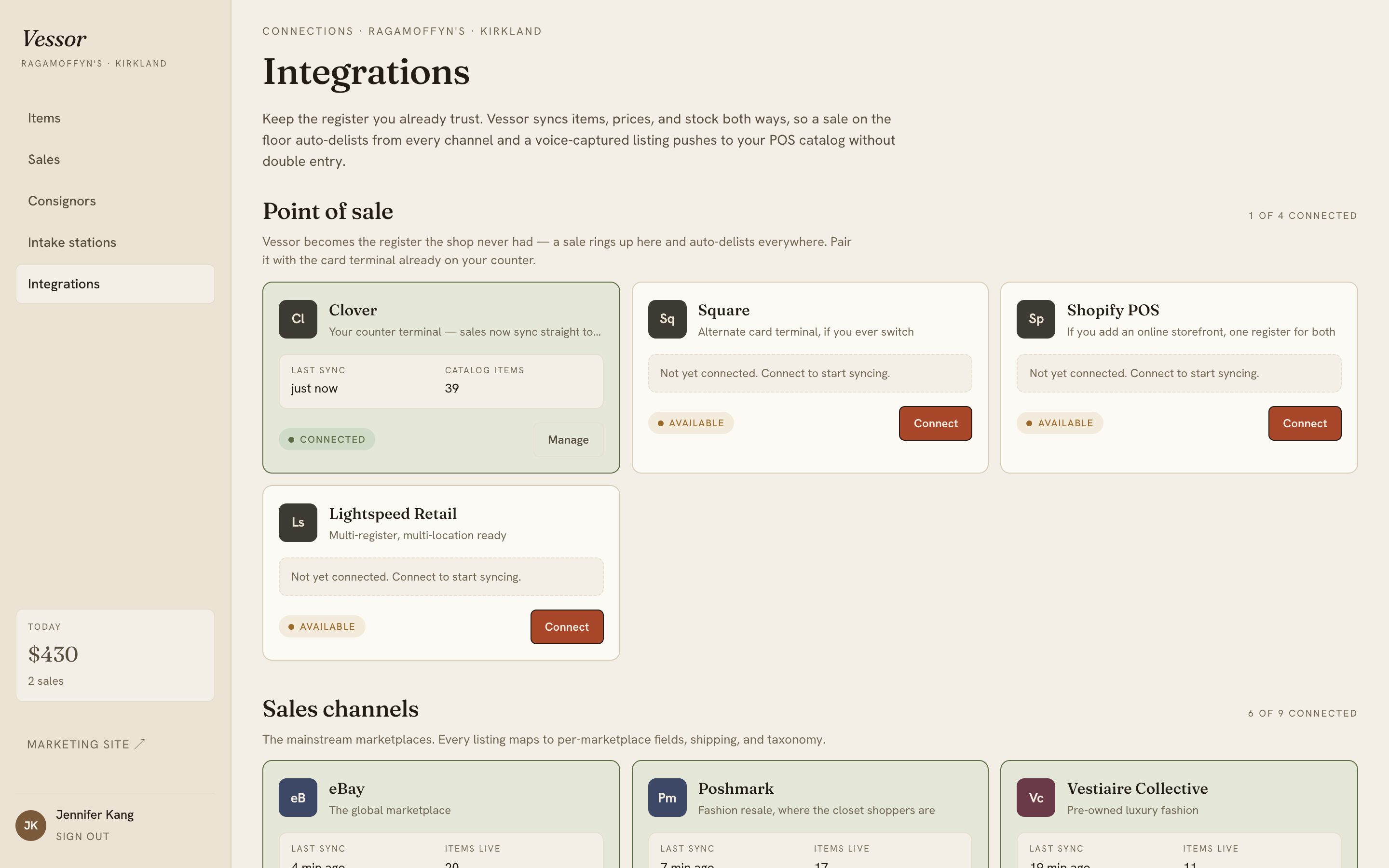
Connects to the register they already run (Clover, Square, Shopify, Lightspeed) and the marketplaces buyers actually use. No forced migration.
Where it stands
Vessor is in private pre-alpha, built alongside design-partner shops with a bespoke instance tailored to each. Discovery validated the core bet: the double-sale guard is the unblock, and one shop went further and asked us to replace its register entirely. I designed the product and the brand and built the front-end. More shops are already in the pipeline.
Reflection
The lesson that transfers: the most valuable thing to build is often the one a customer is afraid of. The whole product earned its shape from a single fear, the double sale. Solve that with conviction and the rest of the work, intake, pricing, payouts, becomes the reason to stay.