← Work
Invisible · 2025

AI Customer Success Agent

Enterprise buyers won't believe agentic AI until they watch it work, safely. I designed and built the Customer Success demo that makes an autonomous agent feel real, credible, and ready to sell.

Role
VP of Product Design · Product Lab
Year
2025
Tools & methods
Figma, Replit, Claude Code, Interaction design, Rapid prototyping

Overview

An AI Customer Success agent, built for Invisible's demo-first sales motion. As VP of Product Design I co-lead Invisible's rapid-prototyping Product Lab, and I designed and built this one end to end: the interaction model, the interface, and the front-end (Figma, Replit, Claude Code). It is the case study of making an abstract idea, a team of AI agents, feel real enough that an enterprise buyer believes it in the room.

The problem

Invisible's sales motion is demo-first: forward-deployed teams spin up bespoke, clickable demos for prospect meetings. The hard part with agentic AI is that it is abstract. No enterprise buyer believes in a "team of AI agents" from a slide. They believe it when they watch one do real work, safely, in the room. Customer Success is the perfect proving ground: relatable, high-stakes, and drowning in noise.

Research & discovery

I sat with customer success managers and watched the real job. It is not reading 47 tickets. It is finding the three accounts quietly slipping toward churn before renewal, without losing trust in how the answer was reached. Two things mattered most: the agent had to speak plain language, because CSMs are not technical, and people had to stay in control.

Testing · affinity map, by participant
Trust the data source
P1“Where did it get that number?”
P3Wanted to see the tickets behind a score
P2Believed it once reasoning was visible
Don’t send without me
P2“It can draft. I hit send.”
P4Auto-send was an instant dealbreaker
P1Approval step felt safe, not slow
Speak plain English
P3Tripped on “churn-risk vector”
P4Wanted it to sound like a teammate
P1–P4 · four customer success managers
Three themes surfaced fast and repeated across participants: show your sources, keep me in control, talk like a person. Every one became a design decision.

Insights: the reframe

  • We assumed buyers wanted more autonomy. They wanted more visibility. Trust beats autonomy, every time.
  • The win was never reading 47 tickets. It was surfacing the 3 accounts that actually matter, before the renewal window opens.
  • People believe an agent that shows its work. Cited evidence, not a confident black box.

Concepts & iteration

Concepts & iteration · what I tried, and what users said
Direction ADropped
Copilot sidebar
Suggests next steps while you work.
TestedToo passive. Users still did all the work themselves.
Direction BDropped
Report generator
Hands over a tidy renewal-risk summary.
TestedA dead end. No way to act on it without leaving the tool.
Direction CKilled
Full autopilot
Triages, scores, and sends outreach on its own.
TestedKilled. In testing, no one trusted an agent that acted silently.
The direction I built
A visible agent that works in the open, then asks.
It does the heavy, multi-step work where you can watch it reason, shows its evidence, and stops at one clear human approval. The autonomy of autopilot, with the trust autopilot never earned.
The autopilot was the obvious pitch, and it tested the worst. People will not hand the wheel to an agent they cannot see. That rejection is what pointed to the model I built the demo around: do the work in the open, then ask.

Testing: what changed

Testing · what users revealed → what I changed
What users revealed
What I changed
Users distrusted any action they could not see happen.
Made the agent’s reasoning visible, step by step, as it works.
Auto-sending outreach was an instant dealbreaker.
Added one clear human approval before anything leaves the building.
A score with no "why" felt like a black box.
Every score shows its evidence and the data it drew from.
Technical phrasing lost the non-technical CSMs.
Plain language a CSM can read cold, no jargon.
I tested with the people who would actually use it. Every change traces to a moment a CSM hesitated, and the through-line was trust.

The solution

An AI Customer Success agent that triages yesterday's tickets, scores renewal risk across the whole book of business, drafts the outreach, and stops for a human to approve. Here is where it solves each problem.
Solution · triage
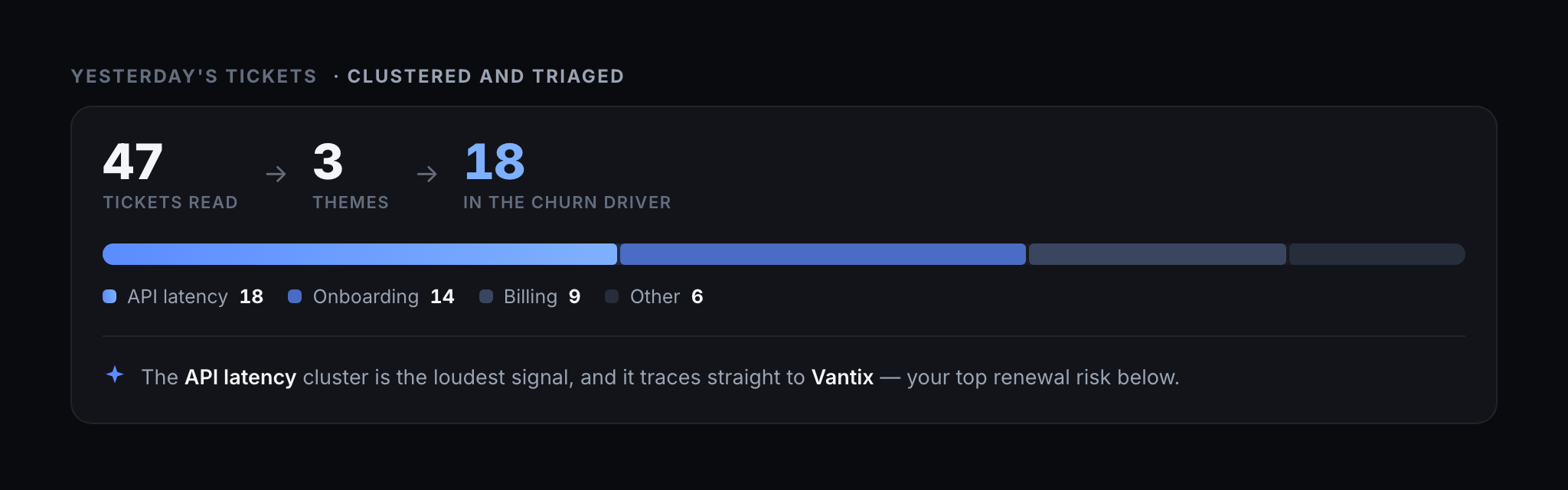
The agent's triage view: 47 tickets read, clustered into 3 themes, with API latency called out as the churn driver in a segmented bar.
Problem it solves: the inbox is noise. The agent turns 47 tickets into one signal, the API-latency cluster that traces straight to the top at-risk account.
Solution · renewal risk
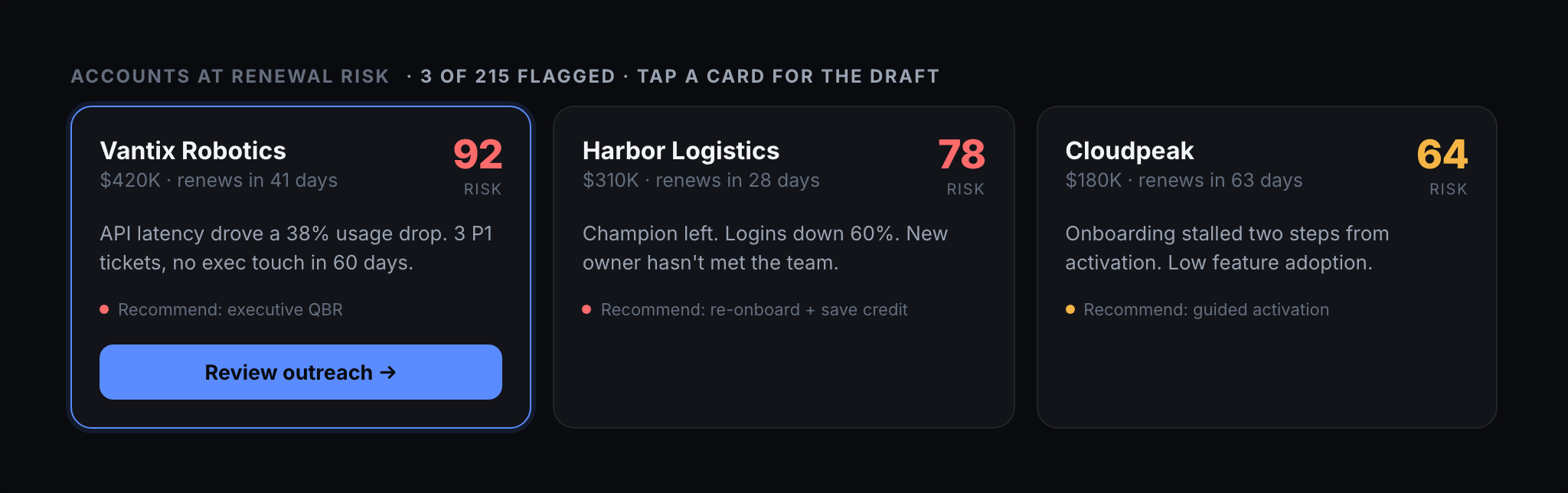
Accounts at renewal risk: Vantix Robotics, Harbor Logistics, and Cloudpeak scored, with Vantix highlighted and a Review outreach action.
Problem it solves: churn hides in a healthy-looking book. The agent ranks 215 accounts and surfaces the 3 that matter, the top one first.
Solution · your call, in one click
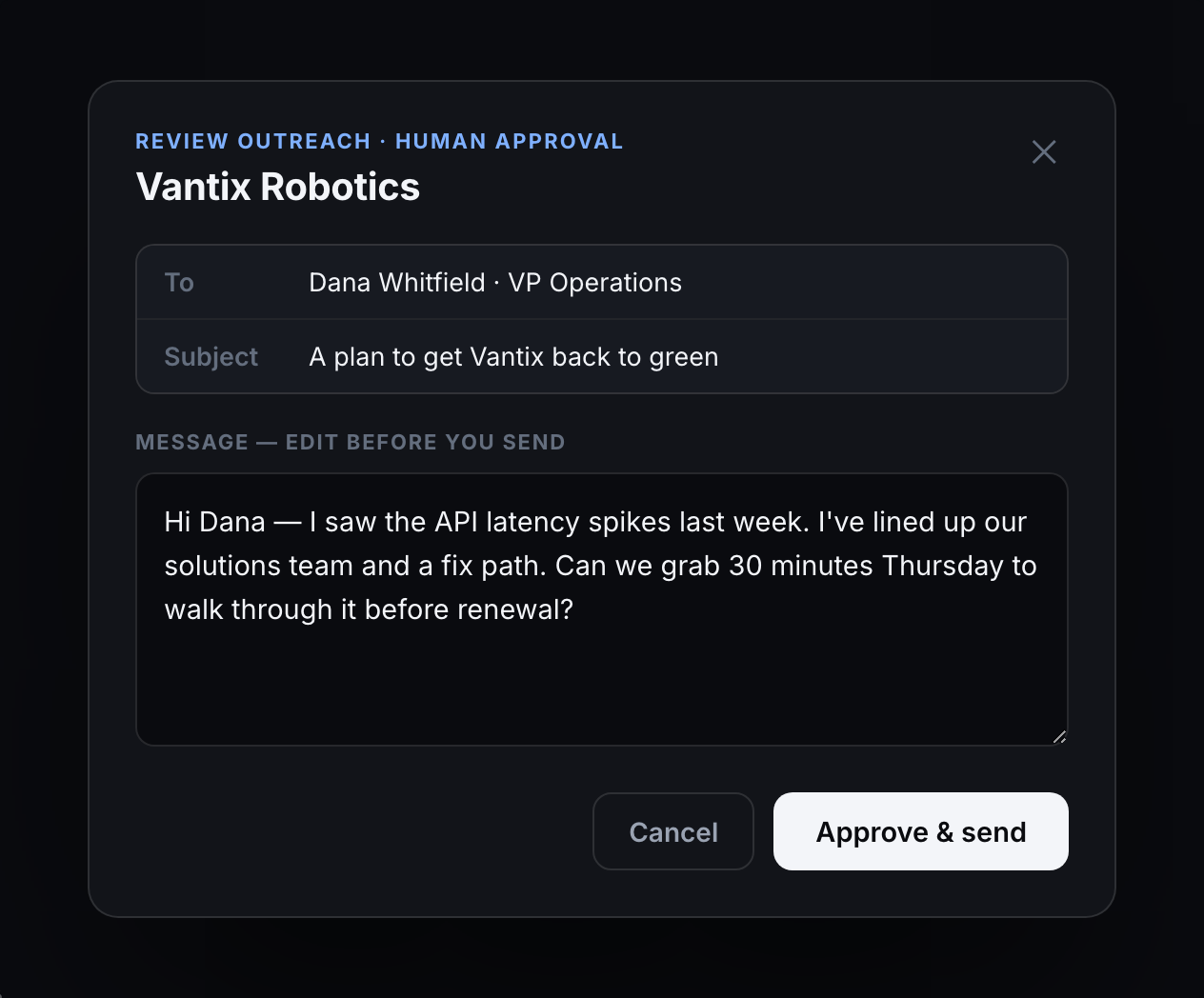
The review-outreach modal: a drafted email to Vantix with an editable body and an Approve and send button.
Problem it solves: no one trusts an agent that sends on its own. It drafts the outreach and stops, editable, for a human to approve.
Solution · approved, and sent
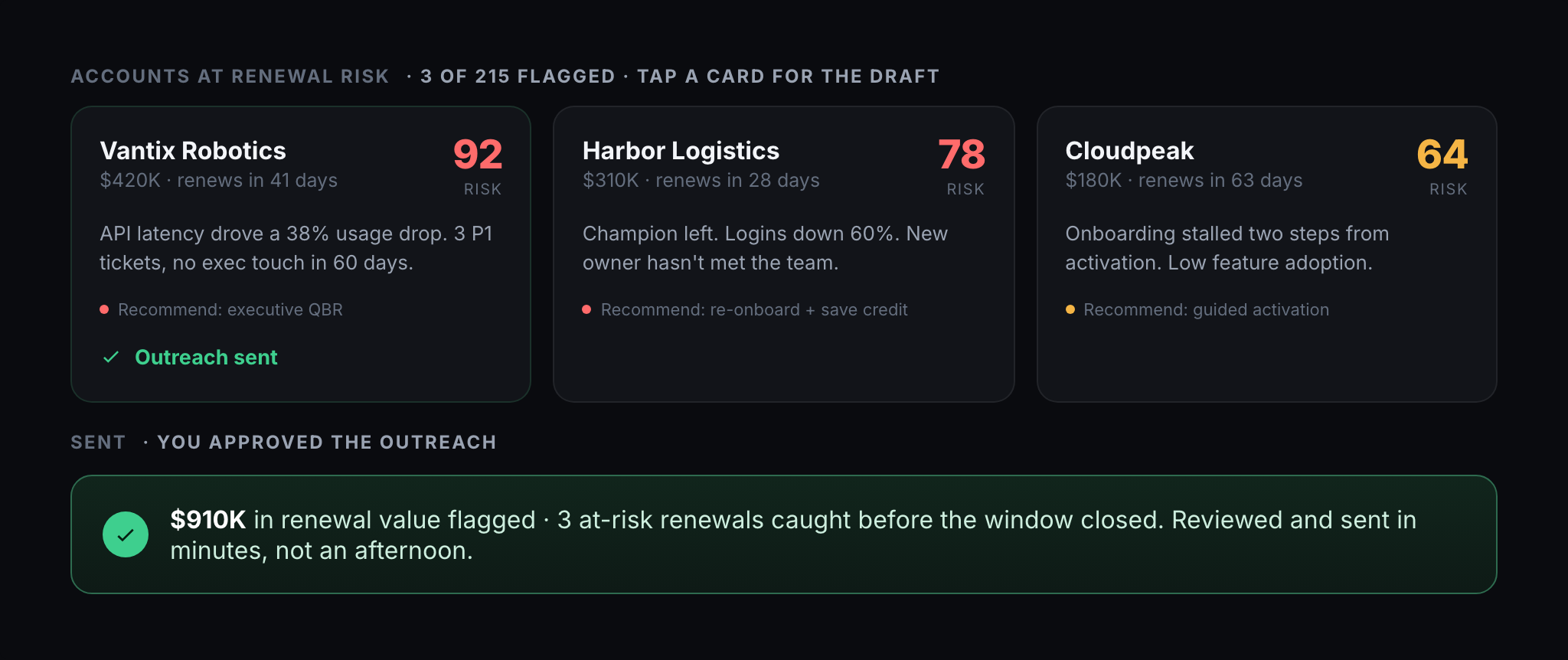
After approval: the Vantix card flips to Outreach sent and a payoff banner reports $910K in renewal value flagged, sent in minutes.
The loop closes. One approval, the outreach is out, and the renewal value it protected is named. Minutes, not an afternoon.

This is the hero running live at the top of the page. The full version is interactive: launch it, edit the draft, and approve it yourself.

Impact

Demos like this are how Invisible sells agentic AI. They turn an abstract pitch into something a buyer can believe, in the room, in minutes. This one makes an autonomous CS agent feel credible and safe at the same time, the kind of demo-first moment that moves an enterprise conversation toward close. I designed and built it end to end.

Reflection

The lesson that carries into every agent I design since: autonomy is not the product, trust is. People do not want a smarter black box, they want to watch the work and keep the final call. Build that in and an agent stops being a parlor trick and starts being something a team will actually run.

0→1
designed & built solo, end to end
3-in-1
triage, risk, outreach, one agent
100%
human-approved before anything sends